








⚡ Quick Answer — Hybrid Fitness Competitions
Hybrid fitness competitions have grown from a few hundred participants in 2018 to well over a million per season by 2026, driven by a standardized, repeatable format that lets everyday gym-goers compete without needing a specialized sport background. HYROX, DEKA, and obstacle course racing are the three biggest names in this space, each combining running with functional strength movements.
In 2018, the first HYROX event drew roughly 650 participants. By the 2025–26 season, that number had climbed past 1.3 million globally. No major fitness format has scaled this fast, and it says something important about where training culture is heading.
We looked at the growth data, the format differences between the major hybrid fitness competitions, and what this trend actually means for athletes training strength and cardio together. Here’s the full picture.
What Are Hybrid Fitness Competitions? (Featured Snippet)
Hybrid fitness competitions are timed events that combine running with functional strength movements in a standardized format, allowing everyday athletes to compete and track progress the same way runners track a 10K time. Unlike CrossFit competitions, which reward broad skill and technical movement mastery, most hybrid fitness competitions prioritize accessible, repeatable exercises over specialized technique.
That accessibility is a big part of why participation numbers look the way they do.
The Numbers Behind the Boom
The growth curve across hybrid fitness competitions has been steep enough to reshape entire categories of the fitness industry in under a decade.
| Season | Approx. Participants | Notable Detail |
|---|---|---|
| 2018 | ~650 | First event held in Hamburg, Germany |
| 2021–22 | ~35,000 | UK affiliate program still under 20 gyms |
| 2024–25 | ~600,000 | Global expansion across 80+ cities |
| 2025–26 | 1.3–1.5 million | World Triathlon approved a related format for Olympic consideration |
That last detail matters beyond the numbers: hybrid fitness competitions are no longer being treated as a passing trend by governing bodies. When an established Olympic federation starts building governance structures around a format, it’s a signal the category is maturing into a real sport rather than a fitness fad. According to a Reuters report on HYROX’s expansion, the format now draws close to 1.5 million participants across more than 35 countries in a single season.
Put another way: it took traditional endurance sports like marathon running and triathlon many decades to reach mass participation numbers in the millions. Hybrid fitness competitions have approached similar scale in roughly a third of that time, which is part of why the category keeps attracting attention from investors, gym chains, and now sporting federations.
💡 Training Tip
If you’re curious how endurance racing is already absorbing strength principles, our IRONMAN 70.3 Worlds Nice recap covers a related shift happening in traditional triathlon.
How Hybrid Fitness Competitions Compare to Traditional Endurance Racing
Marathons and triathlons ask a fundamentally different question of the body than hybrid fitness competitions do. Traditional endurance racing rewards pacing discipline and aerobic efficiency over long, steady efforts. Hybrid fitness competitions instead reward the ability to recover quickly between very different physical demands — sprinting, then lifting, then sprinting again — which is a much closer match to how most hybrid athletes actually train day to day.
This is part of why hybrid fitness competitions have pulled in so many participants who never considered themselves “runners” or “lifters” specifically. The format doesn’t ask you to specialize in one direction the way a marathon or a powerlifting meet does — it rewards being reasonably capable across both, which happens to be exactly what most gym-goers are already building toward without a formal outlet to test it.
Why Hybrid Fitness Competitions Are Growing So Fast
A few factors keep showing up across the fastest-growing hybrid fitness competitions, and none of them are accidental.
- A standardized, repeatable format. Every event follows the same structure, which means athletes can compare times across cities and seasons the same way marathoners compare finish times.
- Low skill barrier. The movements involved are familiar to most gym-goers, unlike CrossFit-style competitions that reward years of specialized technical practice.
- Built-in community and social proof. Team and doubles categories turn training into a shared goal rather than a solo pursuit, which keeps participants coming back season after season.
- Gym affiliate programs. Thousands of gyms worldwide now run official training programs tied to these events, giving everyday members a direct path from workout to competition.
- Olympic ambitions. Governance partnerships with established federations add legitimacy that pure fitness trends usually lack.
None of these factors alone would explain the growth curve. It’s the combination — an accessible format, a built-in community, a commercial pipeline through gyms, and increasing institutional legitimacy — that’s turned hybrid fitness competitions into something closer to a standalone sport than a workout trend.
The Business and Gym Side of the Boom
Part of what makes this growth curve unusual is how directly it’s tied to the gym industry itself, rather than existing independently of it. Gym affiliate programs let local gyms license official branding, training programming, and event pathways, turning regular members into event participants without those members ever having to seek out a specialized facility.
This matters for the broader hybrid training space because it’s created genuine commercial incentive for gyms to build hybrid-specific programming, rather than treating strength and cardio as separate departments. That shift shows up in class schedules, equipment purchases, and coaching certifications well beyond the competitors who actually sign up to race.
Affiliate programs have pushed gyms to build dedicated hybrid-specific coaching and class programming.

HYROX, DEKA, and OCR: Different Flavors of the Same Trend
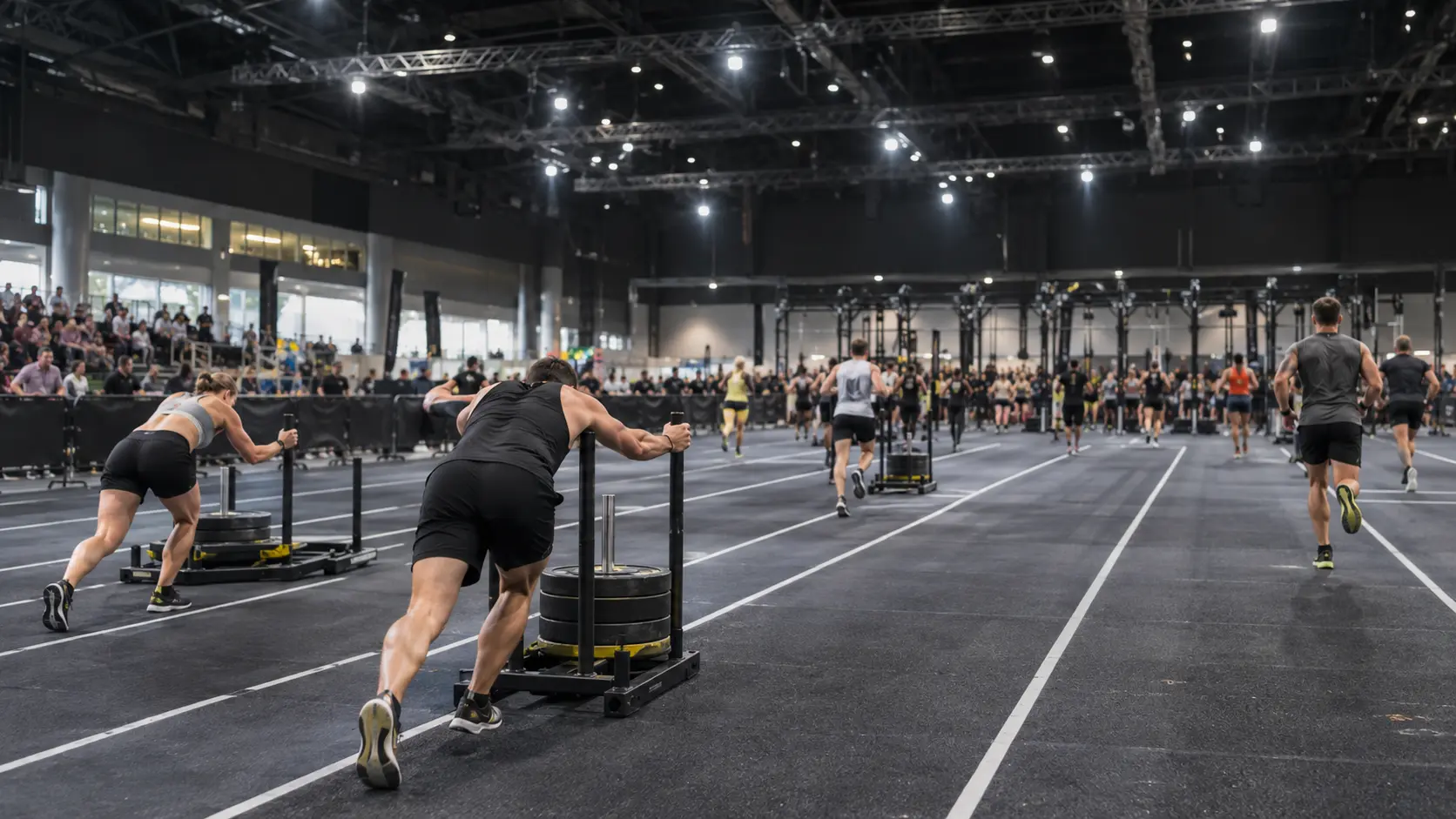
Hybrid fitness competitions aren’t a single format — they’re a growing category with several distinct approaches to the same core idea: pairing running with functional strength work.
HYROX
The largest of the three by participation, HYROX pairs distance running with a fixed set of functional movements between runs, using a consistent format across every global event. Its scale is what’s driven most of the mainstream growth statistics in this space, and its consistency across cities is a big reason athletes can meaningfully compare results season over season.
DEKA
DEKA offers a similar running-plus-functional-movement structure but with more variation in event length and movement selection across its different formats, appealing to athletes who want more variety season to season. It also positions itself with multiple event tiers, which gives newer athletes a lower-commitment entry point than some fixed single-format competitions.
Obstacle Course Racing (OCR)
The oldest of the three categories, OCR adds physical obstacles — walls, crawls, carries — into the running portion rather than discrete strength stations, leaning further toward outdoor, unpredictable terrain. OCR’s longer history means it also has the deepest bench of elite specialists, even as newer entrants are increasingly drawn in through the same general hybrid training base as HYROX and DEKA athletes.
⚠️ Common Mistake
Assuming all hybrid fitness competitions require the same training approach. Format differences between HYROX, DEKA, and OCR mean the ideal preparation isn’t identical across all three.
What This Means If You’re a Hybrid Athlete
If you’re already combining strength training and cardio together, this growth trend is good news rather than a reason to change your programming. Hybrid fitness competitions give structured training a concrete goal and a way to benchmark progress against a standardized event, rather than training in a vacuum with no external measure of improvement.
You don’t need to specialize in the exact movements of a specific event to benefit from this shift. General hybrid training — strength work paired with real cardio volume — transfers reasonably well to most of these formats, since none of them reward pure specialization in either direction.

What the Growth Means for Training Trends Overall
The rise of hybrid fitness competitions is really a symptom of a bigger shift in how people think about fitness. Training for longevity and general capability — rather than purely aesthetic goals — has become one of the most consistently cited fitness trends heading into 2026, and hybrid fitness competitions give that shift a concrete, measurable outlet.
Instead of training toward a vague goal of “being fit,” hybrid fitness competitions let athletes point their training at a specific date, a specific format, and a specific result. That structure is part of what keeps hybrid training programs — the kind built around combining strength and cardio deliberately, rather than as an afterthought — increasingly relevant even for people who never plan to compete.
Common Misconceptions About Hybrid Fitness Competitions
The rapid growth of hybrid fitness competitions has come with some equally rapid misconceptions.
- “You need a CrossFit background to compete.” Most formats are deliberately designed around movements familiar to general gym-goers, not specialized CrossFit skills.
- “It’s only for elite or young athletes.” Participation data shows a meaningful share of competitors are over 30, with many entering as first-timers.
- “You need to specialize your training months in advance.” General hybrid training — the kind covered throughout this site — carries over reasonably well without a highly specific prep block.
- “These events are just a trend that will fade.” Governance partnerships with established sporting federations suggest otherwise, at least for the category’s largest formats.
- “Every hybrid fitness competition trains the same way.” HYROX, DEKA, and OCR reward slightly different qualities, so blindly copying one format’s training plan for another isn’t optimal.
Quick Action Plan: If You Want to Try Your First One
- Pick a format based on what’s actually available near you — local event access matters more than which one looks most appealing online.
- Check the standard event structure and movement list so you know roughly what to expect.
- Continue your normal hybrid training split rather than overhauling everything for one event.
- Add 2–3 practice sessions in the weeks before that mimic the general running-plus-functional-movement pattern.
- Sign up for an entry-level or open category first — competitive categories can wait until after your first event.
- Treat your first event as a benchmark, not a peak performance — most first-timers improve significantly in their second attempt.
FAQ
Do I need to be a competitive athlete to enter hybrid fitness competitions?
No. Most formats offer open or entry-level categories specifically designed for first-time and recreational participants.
Which hybrid fitness competition is best for beginners?
HYROX’s standardized, widely available format tends to be the easiest entry point simply due to how many local and affiliate gym programs already support it.
How much has participation in hybrid fitness competitions actually grown?
From roughly 650 participants at the first event in 2018 to an estimated 1.3–1.5 million during the 2025–26 season — one of the fastest growth curves in modern participation sports.
Do I need special training just for hybrid fitness competitions?
Not necessarily. General hybrid training that combines real strength work with real cardio volume transfers reasonably well across most current formats.
Are hybrid fitness competitions likely to be included in the Olympics?
It’s a stated ambition for at least one major format, supported by a governance partnership with an established Olympic federation — though nothing is confirmed yet.
Why are so many gyms building programs around hybrid fitness competitions?
Affiliate programs give gyms a licensed pathway to turn regular members into event participants, which has created real commercial incentive to build hybrid-specific coaching and class programming.
Bottom line: hybrid fitness competitions aren’t a passing trend — they’re becoming the standardized proving ground for the kind of training this site is built around. Whether or not you ever sign up for one, the boom is a strong signal that strength-plus-cardio training isn’t a niche approach anymore.













Leave a Reply