








⚡ Quick Answer — Hybrid Training After 40
Hybrid training after 40 works best with fewer, better-chosen sessions: at least two strength days a week, most cardio kept easy, one genuinely hard cardio session, and recovery judged by your own signals. Performance declines gradually with age, but a large part of the drop in masters athletes appears linked to a weaker training stimulus, so staying consistent matters more than training harder.
Somewhere in your forties the same training week starts to feel different. Sessions that used to fit around work now compete with family, sleep, and a body that complains more than it used to. Most advice on this topic swings between “you are finished” and “age is just a number,” and neither is useful.
We went through a systematic review of master athletes covering 55 studies, a review of endurance performance in Masters athletes, and the 2020 World Health Organization guidelines to see what holds up. Some of the claims you will read online conflict with each other, so this guide to hybrid training after 40 marks clearly what the evidence supports, what is uncertain, and what is simply our own practical framework.
Hybrid Training After 40: The 6 Changes That Matter
Hybrid training after 40 comes down to six adjustments to the way you already train:
- Make strength training non-negotiable. Aim for at least two strength sessions a week.
- Keep most cardio easy. Reserve one session a week for genuinely hard work.
- Judge recovery by your own signals. Sleep, mood, resting heart rate, and performance tell you more than an age-based rule.
- Protect consistency. Missed weeks cost more than a slightly smaller plan.
- Spread protein across meals. Hit your daily target in feedings of roughly 20–40 g.
- Warm up and progress gradually. Add load or volume in small steps, one variable at a time.
The sections below explain the evidence behind each change, and where the evidence runs out.
What Actually Changes: The Evidence Behind Hybrid Training After 40
The honest summary is that some effects of ageing are well documented, others are disputed, and a few popular claims have little support. A review in the Journal of Physiology on endurance performance in Masters athletes reports that peak endurance running performance is maintained until about age 35, followed by modest decreases until age 50–60, with progressively steeper reductions after that.
That timeline matters for hybrid training after 40, because it means your forties are mostly a period of gradual change, not a cliff. Muscle follows a similar pattern. A commonly cited estimate is a loss of roughly 3–8% of muscle mass per decade, but sources disagree on whether it starts at 30 or 40, and most agree it accelerates after about 60–65.
| Claim | How Well Supported |
|---|---|
| Endurance performance declines gradually from the mid-30s onward | Well documented, modest until 50–60 |
| Muscle mass declines roughly 3–8% per decade | Commonly cited estimate; start age varies by source |
| Resistance training counters age-related muscle loss | Supported by reviews |
| Recovery takes 2–3 times longer after 40 | Conflicting claims, no strong study found |
| A special protein target applies from age 40 | Not established for the 40s and 50s in the sources we found |
| A longer warm-up is needed after 40 | Common coaching advice, no strong age-specific evidence found |
Keep that table in mind as you read about hybrid training after 40. The rest of this guide to hybrid training after 40 leans on the first three rows, and treats the last three as judgment calls rather than rules.
Change 1: Make Strength Training Non-Negotiable in Hybrid Training After 40
If one change matters most, it is this one. The World Health Organization’s physical activity guidelines recommend that adults aged 18–64 do muscle-strengthening activities involving all major muscle groups on two or more days a week, alongside 150–300 minutes of moderate-intensity or 75–150 minutes of vigorous-intensity aerobic activity.
For a hybrid athlete that is not a stretch, because two strength sessions are usually already in the plan. The point of hybrid training after 40 is to protect them when life gets busy, rather than let cardio take their place. Our article on strength training and mortality covers an observational Harvard study in which benefits climbed up to about 90–120 minutes of weekly strength training and then plateaued, and our guide to the minimum effective dose for strength training shows how little volume it takes to maintain strength.
There is also a reason to train both qualities rather than one. A systematic review of muscle morphology and performance in master athletes, covering 55 studies, concluded that lifelong training preserves physical function, muscle strength, and body fat levels in an exercise mode-specific manner. Our reading is that if you only run or ride, you preserve the qualities that cardio trains, and to keep strength you need to lift. One caution: those athletes were over 59 with at least 20 years of training, so the results do not map directly onto someone starting in their forties.
💡 Training Tip
If you follow our 12-week hybrid training plan, you can keep its three-phase structure after 40 and simply protect the deload weeks, which matter more as your recovery margin narrows.
Change 2: Keep Most Cardio Easy When Doing Hybrid Training After 40
The second change is about intensity, and here we rely on our own framework rather than age-specific research. Our guide to Zone 2 training for hybrid athletes explains why roughly 80% of cardio volume should stay easy, leaving about 20% genuinely hard. The logic is practical: easy work builds an aerobic base at a low recovery cost, so the hard session can be hard.
For hybrid training after 40, that structure leaves little room for the grey zone, the moderate effort that feels productive but costs recovery without delivering much in return. A simple version is two easy cardio sessions and one hard session per week, scheduled away from your heaviest lifting day.

Change 3: Judge Recovery by Your Own Signals in Hybrid Training After 40
You will read that recovery takes two to three times longer after 40, and you will also read that masters athletes recover as fast as younger ones. We found both claims in popular sources and no study strong enough to settle it, so we do not recommend a fixed recovery window for hybrid training after 40.
The more reliable approach is to watch your own data. Our guide to recovery for hybrid athletes lists the signals worth tracking: resting heart rate drifting up, lifts and paces slipping in the same week, sleep quality dropping, and soreness that lingers. If two or more appear together, reduce volume before adding anything.
⚠️ Common Mistake
Applying a fixed rule such as “72 hours between hard sessions” as if it were proven. We found no strong evidence for any single number, so use your signals instead.
Change 4: Protect Consistency in Hybrid Training After 40
This is the most encouraging finding for anyone doing hybrid training after 40. A review of masters runners in New Studies in Athletics notes that the reduction in endurance performance appears to be mediated in large part by a reduction in the training stimulus, mainly because of work and family commitments, difficulty following structured programs, and exercise-related injuries.
In plain terms, part of the decline we blame on age may be the decline in how much and how well we train. That puts the focus of hybrid training after 40 where you have control: a plan small enough to survive a busy week beats an ambitious plan you drop by Wednesday. The same logic is behind the minimum effective dose approach, where a modest, repeatable amount of strength work keeps you ahead of the alternative of doing nothing.
Change 5: Spread Protein Across Meals in Hybrid Training After 40
Protein is where many popular articles overreach. You will find claims that masters athletes need 35–40 g per meal or a higher daily target than younger athletes, but the sources making them were blogs, not position stands. The International Society of Sports Nutrition position stand on protein gives 1.4–2.0 g per kg per day for most exercising people, and suggests roughly 0.25 g per kg, or 20–40 g, per serving, spread evenly across the day.
That range already covers hybrid training after 40, so we do not suggest a separate target. The practical lever is spreading it out rather than loading dinner, and our guides to nutrition for hybrid athletes and meal prep for hybrid athletes show how to do it on a busy week.
Change 6: Warm Up and Progress Gradually in Hybrid Training After 40
This change comes from coaching practice, not from a trial. The same masters-runner review lists injuries as one of the factors that reduce training, which makes avoiding them a way of protecting your stimulus. We did not find strong age-specific evidence for how long a warm-up should be, so treat the following as sensible habits rather than rules.
- Warm up progressively. Start with easy movement and build to working loads or paces instead of jumping in cold.
- Change one variable at a time. Add load, volume, or intensity in separate weeks so you can see what your body is reacting to.
- Respect sharp or joint pain. Our guide to running after leg day explains how to tell normal soreness from a problem.
- Keep deloads in the plan. A lighter week every few weeks is cheaper than an injury.
A Sample Week of Hybrid Training After 40
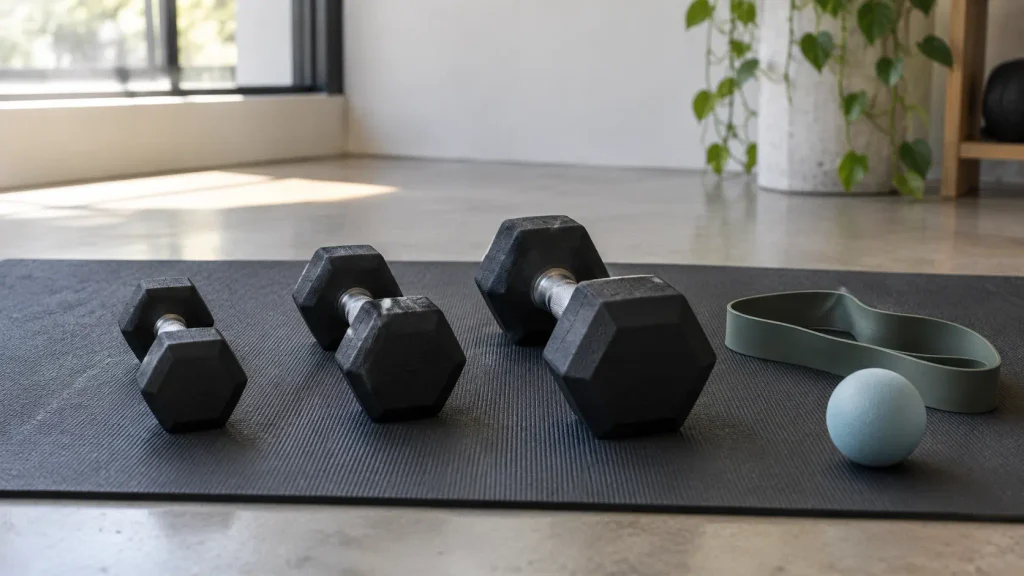
The week below is an illustration of hybrid training after 40 built from the principles above, not a study-backed protocol. It keeps two strength sessions, two easy cardio sessions, and one hard session with at least a day between hard efforts, and it lands at roughly 90 minutes of strength work.
| Day | Session | Notes |
|---|---|---|
| Monday | Strength A (squat or lunge, hinge, push, pull) | About 45 minutes, leave a rep or two in reserve |
| Tuesday | Easy cardio | 30–45 minutes, conversational pace |
| Wednesday | Rest or a walk | Protect sleep |
| Thursday | Strength B (different variations) | About 45 minutes |
| Friday | Easy cardio or rest | Optional, keep it light |
| Saturday | One hard cardio session | Intervals or tempo, after a proper warm-up |
| Sunday | Rest | Full rest, sleep priority |
Adjust the days to your calendar, but protect the two strength sessions first and the gap before and after the hard cardio day second. If a week falls apart, repeat it rather than trying to catch up.
When to Talk to a Doctor Before Hybrid Training After 40
Hybrid training after 40 is safe for many healthy adults, but a few situations call for medical advice first. If you are returning after years of inactivity, have a heart, lung, or joint condition, take medication that affects heart rate or blood pressure, or notice chest pain, unusual breathlessness, or dizziness during exercise, speak to a doctor before increasing intensity.
🚨 Important
This is general training information, not medical advice. If you feel chest pain, severe shortness of breath, or dizziness while training, stop and seek medical attention.
6 Mistakes People Make With Hybrid Training After 40
Most problems with hybrid training after 40 come from copying a plan built for a different stage of life.
- Dropping strength training when time gets tight. Cardio feels more urgent, but strength is the quality that needs protecting.
- Training in the moderate zone all week. Without easy days and a genuinely hard day, recovery suffers and progress stalls.
- Following a fixed recovery rule. No single number is proven, so watch your signals instead.
- Chasing your 30-year-old numbers. Comparing today’s session with your best from a decade ago invites overreaching.
- Adding load, volume, and intensity at the same time. Change one variable per week.
- Skipping deload weeks. They are the cheapest insurance against missed training.
FAQ
Is hybrid training after 40 a good idea?
For most healthy adults, yes. Strength and cardio together support the physical qualities that decline gradually with age, and the WHO recommends both aerobic activity and muscle-strengthening on two or more days a week.
How many strength sessions should I do in hybrid training after 40?
At least two per week is the standard guideline. Two structured sessions of about 45 minutes also matches the volume at which benefits plateaued in Harvard’s observational study.
Do I need more recovery time for hybrid training after 40?
Possibly, but the evidence is conflicting. Rather than a fixed rule, track sleep, resting heart rate, mood, and performance, and reduce volume when several drop together.
Do I need more protein for hybrid training after 40?
The ISSN range of 1.4–2.0 g per kg per day already applies to most exercising adults. We did not find strong evidence for a separate higher target in the 40s and 50s.
Can I still get faster or stronger with hybrid training after 40?
Yes, particularly if you were not training consistently before. Much of the decline seen in masters athletes appears linked to a weaker training stimulus, so a better plan can recover ground.
How many hard cardio sessions fit into hybrid training after 40?
One is a sensible starting point for most hybrid athletes, with the remaining cardio kept easy. Increase only if your recovery signals stay stable.
Quick Action Plan: Your First Month of Hybrid Training After 40
Use this sequence to start hybrid training after 40 without overhauling your life:
- Schedule two strength sessions of about 45 minutes in your calendar before anything else.
- Convert your cardio to two easy sessions and one hard session per week.
- Choose three recovery signals to track, such as sleep, resting heart rate, and how your lifts feel.
- Set a daily protein target in the 1.6–2.2 g per kg range and split it over three or four meals.
- Change only one variable per week, and keep a lighter week every few weeks.
- If a week falls apart, repeat it instead of cramming missed sessions into the next one.
Bottom line: hybrid training after 40 is less about doing less and more about protecting what matters most, which is consistent strength work, mostly easy cardio, and a plan small enough to survive real life. For more on building and keeping strength, browse our Strength & Conditioning section.











Leave a Reply